Home
R O S E K O R B E R A R T
For more than 20 years, Rose Korber has played a significant role in introducing South African artists to a local as well as an international art market. Over the years, she has become widely known for showcasing the best of innovative, contemporary South African art. In a unique gallery attached to her home in Camps Bay, clients can view an extensive selection of quality paintings, mixed media works, limited-edition original prints, photography, sculpture, ceramics, Rorkesdrift tapestries and contemporary beadwork.
Latest news…
Noted Johannesburg artist, Sam Nhlengethwa – regarded as one of South Africa’s leading contemporary artists – is our featured artist for the month of March. Born into a family of jazz lovers, Sam acquired a passion for jazz saying “I think, at heart, I am a non-practising jazz musician.” That passion reverberates through his art, and is a theme he returns to repeatedly.
But Sam’s interests are much more wide-ranging than the jazz theme alone: his work is largely figurative and he has explored many other themes that are close to his heart, such as the plight of mineworkers (MINE TRIP, 1996); the physical space of contemporary Africa (INTERIORS, 1998, 2003, 2008 and 2011); reminiscences of the political and personal (GLIMPSES OF THE 50’S AND 60’S, 2004); life in the townships (THE TOWNSHIP SERIES, 2005), and the remarkable suite of lithographs which are a tribute to six particular South African artists he has most admired – William Kentridge, Marlene Dumas, Dumile Feni, Judith Mason, David Koloane and Peter Clark (TRIBUTE SERIES, 2008).
Sam Nhlengethwa is on show at Rose Korber Art from 1 to 31 March with a show entitled OF JAZZ, INTERIORS, TRIBUTES AND TOWNSHIPS: RECURRING THEMES IN THE WORK OF SAM NHLENGETHWA. To view all the works on show click here.
Important features of the website…
Through our constantly updated website, we will inform our clients of new acquisitions, exhibitions and on-going developments at Rose Korber Art. We aim to provide an extensive archive of our works by leading and emerging contemporary South African artists. Our Artists’ Section has a complete alphabetical listing of our artists, with each artist’s name linking to a page with information on the artist plus an overview of works in stock by that artist.
Throughout the year, we hold online exhibitions in which we feature an Artist of the Month with comprehensive information on the artist and their works.
We also have a Special Purchases section, where we offer clients a range of works of particular interest – with a distinct investment potential – by both South African and international artists.
Under Archive we show a retrospective of artists’ works that are no longer available for purchase. If there are works in this section that you are interested in, please let us know as we may be able to acquire the work on your behalf.
A selection of original, hand-made, museum-quality beadwork pieces are also on view at Rose Korber Art, plus an array of traditional dolls from different areas in South Africa and a selection of South Africa’s finest ceramics.
Please note that we also offer clients a number of specialised services, including:
- Advice on collecting and investing in art;
- Assistance with framing and hanging of artworks purchased;
- Facilitating the packing, insuring and airfreighting of these works to
anywhere in the world.
To contact Rose Korber Art:
48 Sedgemoor Road, Camps Bay
Cape Town 8005
SOUTH AFRICA
Tel: + 27 (0)21 4389152
Cell: + 27 (0)83 2611173
+ 27 (0)82 7816144
Fax: + 27 (0)21 4386262
Email: info@rosekorberart.com
Facebook: Click here
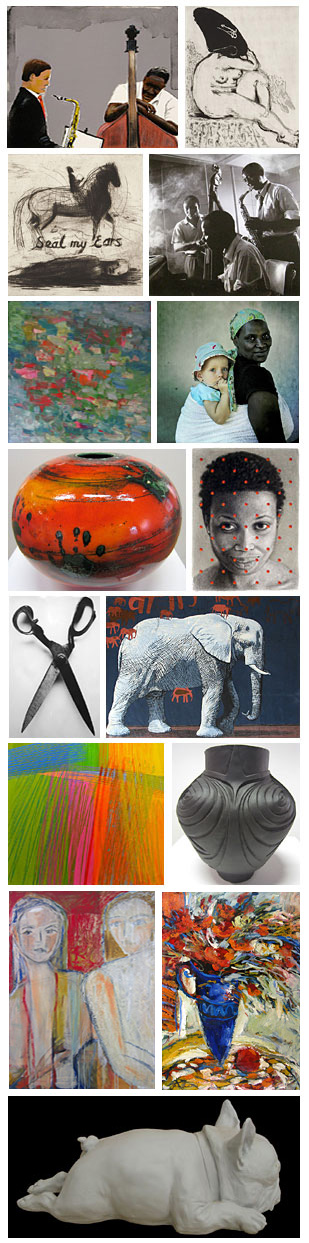
Works illustrated, clockwise:
First Row: Sam Nhlengethwa, William Kentridge
Second Row: Deborah Bell, Jurgen Schadeberg
Third Row: Penelope Stutterheime, Dale Yudelman
Fourth Row: Laura du Toit, Richard Smith
Fifth Row: Stephen Inggs, John Moore
Sixth Row: Paul Blomkamp, Jenny Chadwick
Seventh Row: Philip Badenhorst, Georgia Lane
Eighth Row: Francois van Reenen
Thank you Section
Past supporters included below.
We’ve met some amazing supporters of Rose Korber Art over the years. Many contributors have made it possible to produce inspiring and memorable pieces of art.
The team at NO1 Carports submitted this nice little mural artwork on the back of a carport in Brisbane.